Abolish ICE: Quad Cities Protest Marks a Turning Point
Abolish ICE: Quad Cities Protest Marks a Turning Point
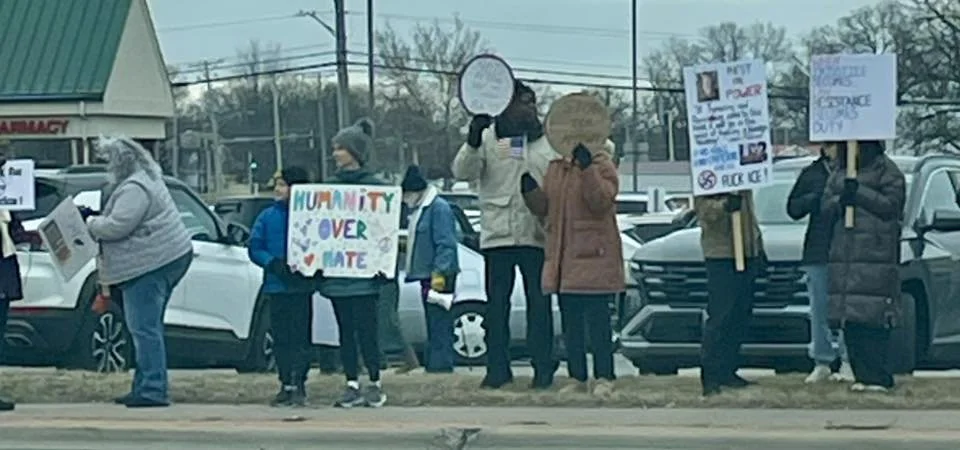
The Quad Cities witnessed a powerful moment of collective outrage and solidarity this week as nearly one thousand people filled the Avenue of the Cities to demand justice and accountability following the killing of Renee Good. What began as a simple call to protest quickly transformed into one of the largest abolitions‑focused demonstrations the region has seen in years. The scale and urgency of the turnout signaled a shift in local political energy and a refusal to accept silence in the face of state violence.
The protest brought together an unusually broad coalition of organizations: the Party for Socialism and Liberation, Nefesh, One Human Family, Indivisible, and Liberty and Justice, among others. Each group arrived with its own history, its own community, and its own reasons for standing against ICE and the systems that enable it. But on this day, those differences dissolved into a unified demand: the violence must end, and the institutions responsible must be dismantled.
What made the protest so striking was not only its size but its tone. This was not a symbolic gathering or a routine rally. It was a community grieving, angry, and unwilling to let the death of Renee Good be swept aside. Speakers emphasized the human cost of ICE’s presence families torn apart, communities terrorized, and lives ended without accountability. The crowd responded with chants that echoed for blocks, a reminder that the Quad Cities is not the quiet, compliant region some assume it to be.
The protest was organized and amplified rapidly through Quad Cities Indivisible channels, with posts circulating across Facebook and local networks. Within days, organizers had mobilized a massive crowd. One Human Family has already announced another major protest next week to maintain momentum, and Nefesh is preparing additional actions in both Iowa City and the Quad Cities. The movement is not slowing down.
For many attendees, this was the first time they had seen the Quad Cities come together at this scale for an abolitionist cause. The turnout nearly a thousand people sent a message that cannot be ignored: the community is watching, and it refuses to be silent.
The killing of Renee Good has become a catalyst. It has exposed fractures in local institutions, failures of oversight, and the deep harm inflicted on marginalized communities. But it has also revealed something else: a growing willingness among everyday people to confront these injustices directly and publicly.
If this protest showed anything, it’s that the movement to abolish ICE is no longer confined to major cities or national headlines. It is here, in the Quad Cities, carried by people who refuse to accept a world where state violence is normal and unchallenged.
The question now is not whether the protest was successful it clearly was but what comes next. Movements are built on moments like this, and the Quad Cities has shown it is ready to stand up, speak out, and demand a different future. The challenge ahead is transforming this spark of anger into sustained community building and into visions of parallel structures of power structures rooted in care, safety, and collective liberation.
Organizations Present at the Protest
Party for Socialism and Liberation (PSL): https://pslweb.org
Nefeshlozen (this website)
One Human Family QCA: https://onehumanfamilyqca.org
Indivisible (national site): https://indivisible.org
Liberty and Justice for All (regional civic org; closest match): https://www.libertyandjusticeforall.org
Visibility Brigade
Background on ICE, Abolition, and State Violence
ACLU: “The Case for Abolishing ICE”
https://www.aclu.org/news/immigrants-rights/the-case-for-abolishing-ice (aclu.org in Bing)
Human Rights Watch: “Systemic Abuses in ICE Detention”
https://www.hrw.org/topic/immigration/immigration-detention (hrw.org in Bing)
National Immigrant Justice Center: ICE oversight failures
https://immigrantjustice.org/issues/immigration-detention (immigrantjustice.org in Bing)
General Reporting on ICE‑related deaths and accountability
NPR: “Deaths in ICE Custody Raise Questions About Oversight”
https://www.npr.org/2020/06/09/873007927/deaths-in-ice-custody-raise-questions-about-oversight (npr.org in Bing)
The Guardian: “ICE under fire for medical neglect and abuse”
https://www.theguardian.com/us-news/immigration (theguardian.com in Bing)
Protest & Movement Context
Harvard Kennedy School: “What Makes Protests Effective”
https://www.hks.harvard.edu/research-insights/policy-topics/social-policy/what-makes-protests-effective (hks.harvard.edu in Bing)
Brookings: “The Power of Local Movements”
https://www.brookings.edu/articles/the-power-of-local-movements (brookings.edu in Bing)
